

|
IN BRIEF
|
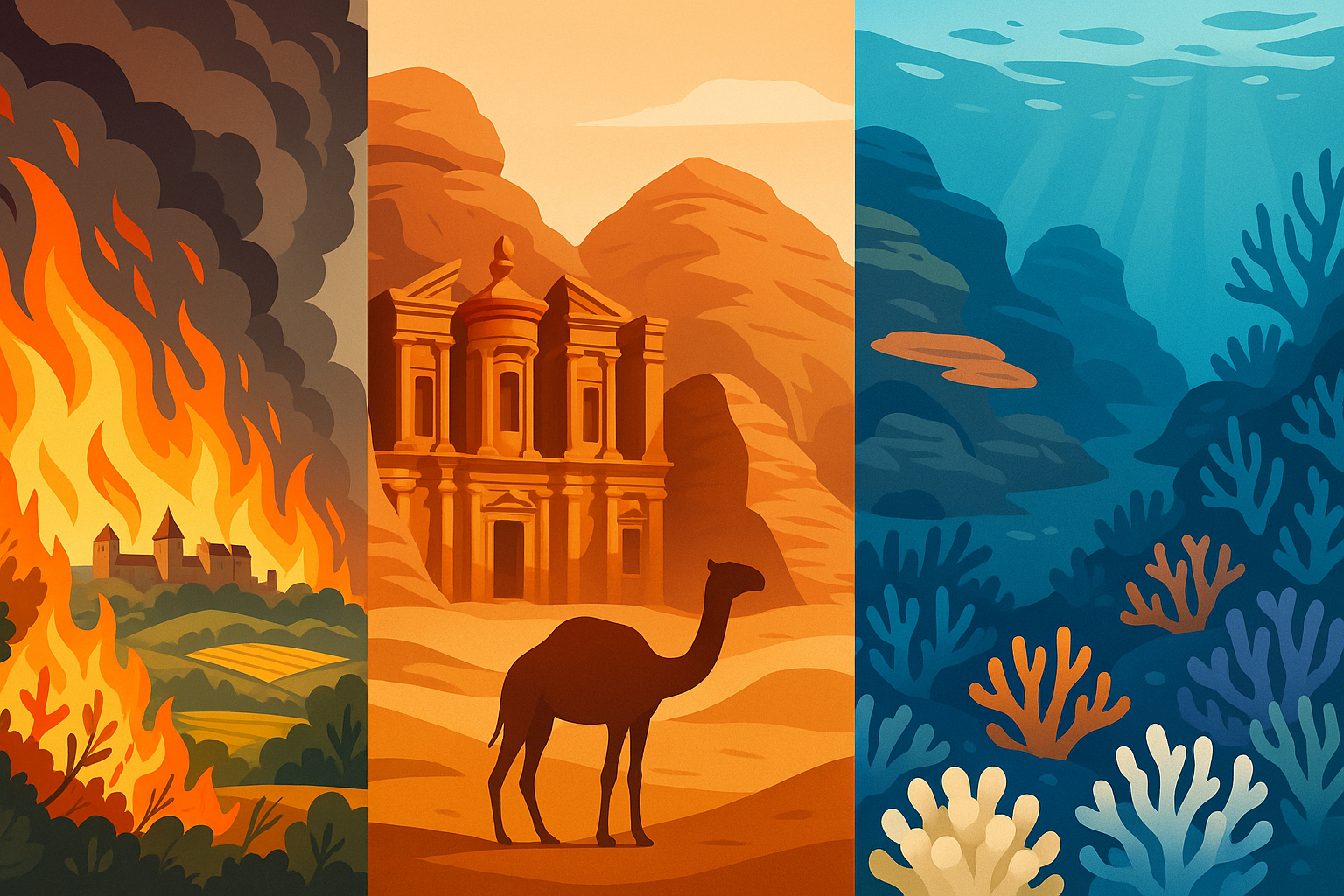
In the face of international news marked by natural and human disasters, several regions of the world are undergoing severe upheavals. A wildfire of unprecedented scale is currently ravaging the Aude department in southern France, severely testing firefighters and residents. At the same time, Jordan is witnessing its tourism sector collapse due to the consequences of the Middle Eastern conflict, while the Great Barrier Reef in Australia is facing massive bleaching, an alarming symptom of climate change. This article provides a detailed account of these three major events and outlines the close ties between climate change, regional instabilities, and human impact.
A major wildfire ravages Aude in France
Since Tuesday afternoon, an exceptionally violent wildfire has been consuming the Aude department in southern France. In just 24 hours, the flames have devoured 16,000 hectares of vegetation, equivalent to one and a half times the area of Paris, according to authorities. This is one of the largest fires recorded in the country since 1949. The Prime Minister, François Bayrou, does not hesitate to describe the situation as a “ catastrophe of unprecedented magnitude,” emphasizing that climate change is an aggravating factor.
With a progression estimated at 5 km/h, the flames are climbing the hills due to extremely dry vegetation, strong winds, and a sloping terrain that favors their development. Despite the mobilization of over 2,150 firefighters, 600 ground vehicles, and about twenty aircraft, the fire continues to advance. The human toll rises: one person has died, while thirteen others, including eleven firefighters, have been injured. One of the victims among the rescue services was seriously injured in a road accident.
This tragedy recalls other recent major fires that have occurred in Europe and around the world, such as the disaster described in Punta Cana, or the fires in Athens, for which practical advice is given on this site. The shadow of climate change looms heavily, increasing the frequency and intensity of these disasters in Mediterranean regions, as illustrated by the airport news in Heathrow, which has been disrupted due to wildfires (see here).
Tourism in Jordan is collapsing
While France faces nature in fury, Jordan must deal with heavy economic and social consequences stemming from the Israeli-Palestinian conflict. Since the attack of October 7, 2023, the Jordanian tourism sector, a pillar of the national economy, is collapsing. There has been a brutal drop of 60% in the number of visitors between 2023 and 2024. This sharp decline particularly affects iconic sites like the ancient city of Petra, where almost half of the hotels have been forced to close. Similarly, many restaurants and souvenir shops are pulling down the shutters.
Tour guides testify to the precariousness of their activity: now, only a few local visits or those coming from Gulf countries endure, primarily independent travelers who demand fewer services. Furthermore, American, Chinese, and European tourists are becoming increasingly scarce, leading to a massive postponement of trips. This phenomenon has also struck other destinations, victims of insecurity or overtourism, as revealed by the experience in Bruges with measures taken against overtourism or the recent removal of certain UNESCO heritage sites (learn more).
The financial loss for Jordan is considerable. According to industry professionals, such as French tour operators, booking portfolios for the coming months are historically low. Tourism, previously a crucial source of foreign currency and jobs, is experiencing an unprecedented crisis.
The Great Barrier Reef in Australia is experiencing alarming bleaching
On a completely different continent, a true ecological tragedy is unfolding. The Great Barrier Reef of Australia is currently experiencing its gravest and most extensive bleaching episode ever recorded. Between August 2024 and May 2025, the southern and northern branches of the reef have undergone a record annual decline. The white color that is spreading over the corals reveals a particularly concerning state of health for this ecosystem, one of the richest in the world.
The causes are multiple: tropical cyclones, invasions of crown-of-thorns sea stars that feed on corals, but the main reason, according to the Australian Institute of Marine Science, remains the rise in ocean temperature due to climate change. When the water gets too warm, corals expel the microscopic algae with which they live in a symbiotic relationship. Deprived of these algae, they bleach, weaken, and can die if high temperatures persist.
The year 2024 was marked by a record surface temperature around Australia. The rapidly growing acropora coral, which is more sensitive to temperature increases, has been particularly affected, exacerbating the seriousness of the situation. This alert regarding the Great Barrier Reef resonates as other natural sites also see their fragility exposed, highlighting the urgency to act to protect biodiversity in the face of global upheavals.


